

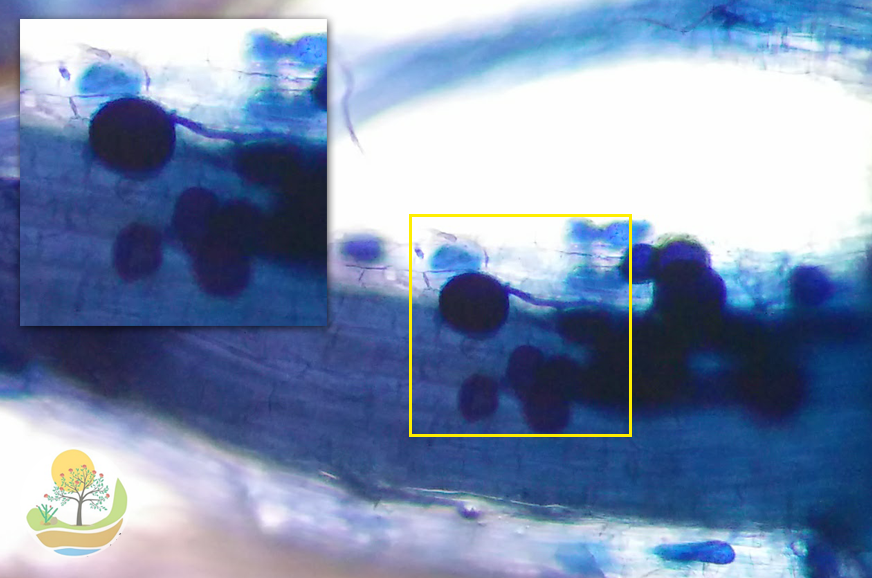
Mycorrhizal spores germinating inside root of Enterolobium contortisiliquum.
The term mycorrhizae refer to a symbiotic association that occurs between fungi and plant roots. These fungi colonization benefits the host plant with a more efficient absorption of water and nutrients, reduces losses by biotic and abiotic stresses, and improves photosynthetic efficiency and root growth. In exchange, these microorganisms receive carbohydrates from the plant (produced by photosynthesis). This association occurs naturally under the most diverse environmental conditions, and it is considered the most common symbiotic association present in the soils.
There are two kinds of mycorrhiza found in trees: ectomycorrhizas and endomycorrhiza (or arbuscular mycorrhiza). The arbuscular mycorrhizal fungi (AMF) colonize a wide range of plants, from Bryophytes to Angiosperms. Their structures, when colonizing roots, penetrate the cells and, unlike the ectomycorrhizal, cannot be seen in the naked eye. Hyphae that growth outside the cells grows up to 8 cm from the root surface, increasing plants capacity to absorb low-mobility nutrients. This characteristic is important in tropical regions, where Phosphorus is one of the main nutrient limiting agriculture.
As part of the Projeto Caatinga, a mycorrhizal bank is maintained with six isolates of five different genres (Gigaspora margarita, Dentiscutata heterogama, Rhizophagus clarus, Acaulospora colombiana, Claroideoglomus etunicatum, and Acaulospora scrobiculata), obtained from the Coleção de Fungos Micorrízicos Arbusculares da Embrapa Agrobiologia (Seropédica, RJ, Brazil) and studies are developed to evaluate the effect of AMF inoculation on native species of Caatinga.
MYCORRHIZAL FUNGI STAINING TEST
The staining test is performed to verify the colonization of arbuscular mycorrhizal fungi in plant roots, indication if the mutualistic interaction between plant and fungi was formed or not. The procedure consists on the discoloration of root fragments in KOH solution (10%) for 30 minutes at 90°C followed by 30 minutes in HCL 3M at room temperature. After discoloration, root fragments are placed in a container with trypan blue (0.1%) for 8 minutes at 90°C. Colored fragments are kept in glycerol 50% until visualization in microscope (GONÇALVES et al., 2016).
PUBLICATIONS
Efeito da inoculação de fungos micorrízicos arbusculares e adubação fosfatada na produção de mudas de Enterolobium contortisiliquum
- Authors: Luan Vítor Nascimento, Márcia Michelle de Queiroz Ambrósio, Afonso Luiz Almeida Freires, Tatianne Raianne Costa Alves, Geovane de Almeida Nogueira
- Event: XXIV Seminário de Iniciação Científica da UFERSA (XXIV SEMIC, 2018)
- Language: Portuguese
- Access: Download here
<Go back to Microbiology page>
REFERENCES
- COLOZZI-FILHO, A.; BALOTA, E. L. Micorrizas arbusculares. In: HUNGRIA, M.; ARAÚJO, S. R. (Eds.). Manual de métodos empregados em estudos de microbiologia agrícola. Brasília: Embrapa, 1994. p. 383-418.
- CRAM, M. M.; DUMROESE, K. R. Mycorhizae in Forest Tree nurseries. In: CRAM, M. M. F. e MALLAMS, K. M. (Eds). Forest Nursery Pests. Washington, DC: Agriculture Handbook, Forest Service, 2012. p. 20–25.
- GONÇALVES, A. B. S.; GOMES, E. A.; LANA, U. G. P.; SOUSA, S. M.; GUIMARÃES, C. T. Estabelecimento de metodologia para análise e quantificação da colonização por fungo micorrízico arbuscular em milho. In: XXXI Congresso Nacional de Milho e Sorgo; 2016; Bento Gonçalves, Rio Grande do Sul.