
General information
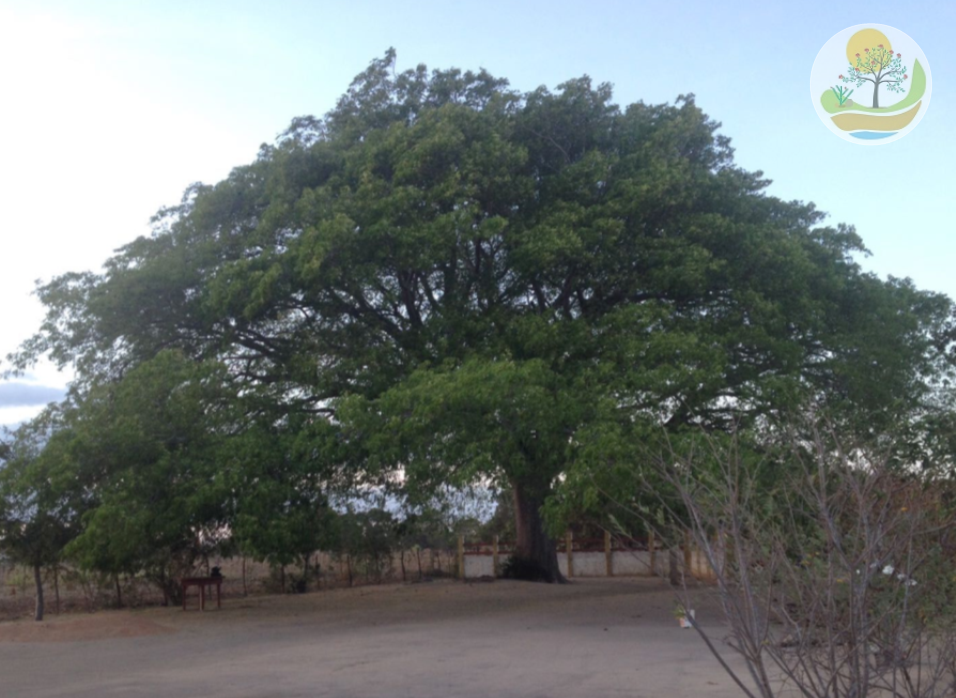
Adult tree (Enterolobium contortisiliquum).
Popularly known as orelha-de-negro, timboril, orelha-de-macaco, timbaúba, timbaúva, timboúva, timbó, tambaré, ximbó, pau-de-sabão pacará, and vinhático-flor-de-algodão (LORENZI, 2008; ARAUJO; SOBRINHO, 2011). The Enterolobium contortisiliquum (Vell.) Morong is a native tree from the Caatinga. It belongs to the Order Fabales, Family Fabaceae-Mimosoideae (APG III, 2017).
The Timbaúba is a big tree, with 20 to 35 m (65.6 to 98.4ft) high, with grayish thin bark. Rhytidome with lenticels (slightly grooved), and a diameter of 80 to 160 cm (2.6 to 5.2ft). Trees with wide crown (LORENZI, 2008).
Spiral alternate leaves (1 to 1.5 cm long), bipinnate, lanceolate to oval leaflets (glabrous). Flowers usually white arranged in axillary umbels. Dark pod-type fruit, contorted shape and indehiscent, with yellowish hard seeds (LORENZI, 2008).
Light wood (density of .54g/cm³), soft cut, low resistance (LORENZI, 2008).
It blooms between mid-September until November. Fruit maturation occurs during June and July but stays in the tree for a few more months (LORENZI, 2008).
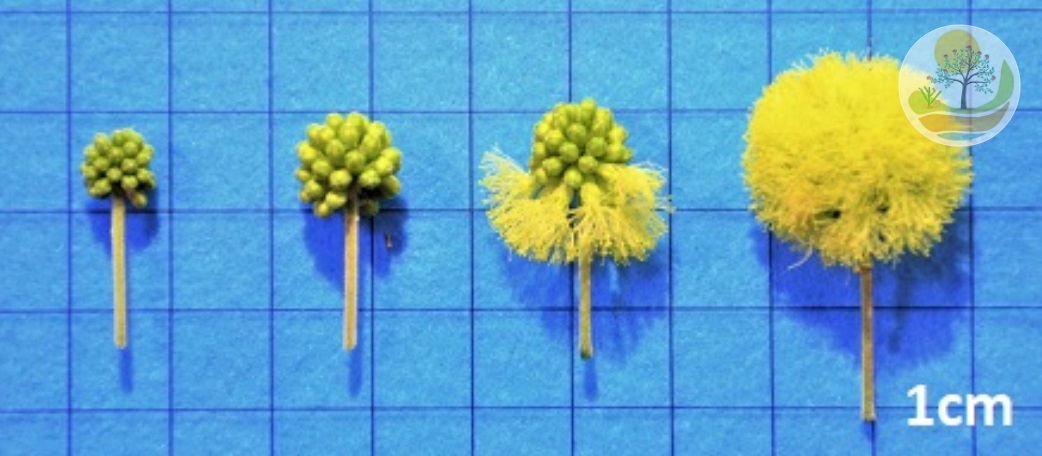
Phases of the inflorescence (Enterolobium contortisiliquum
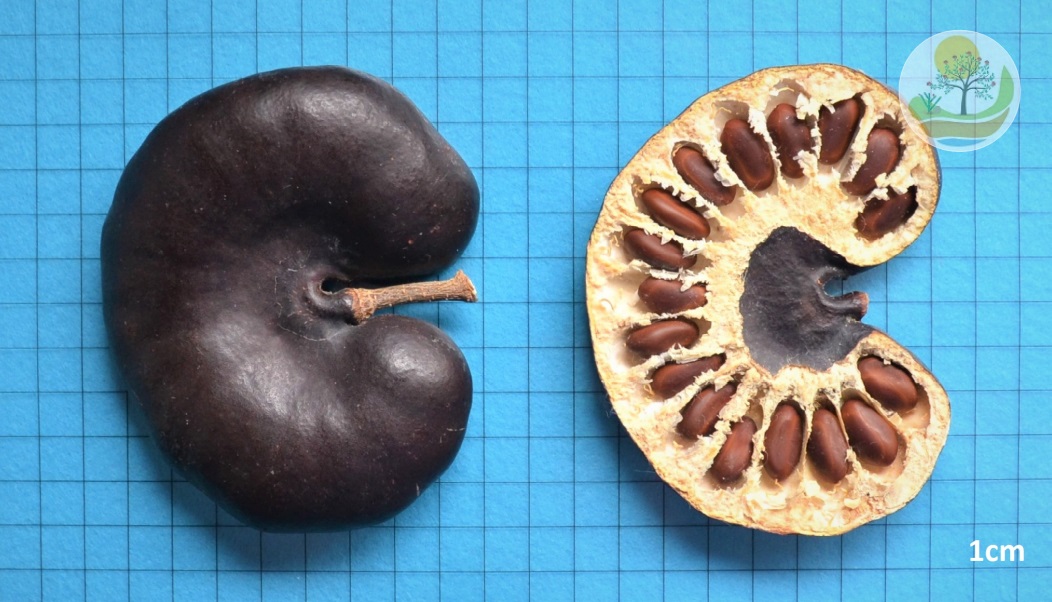
Fruit of Enterolobium contortisiliquum.
Geographical distribution
States of Pará, Maranhão, Piauí, Mato Grosso do Sul, and Rio Grande do Sul, in the rainforests and semi-deciduous forests. Is particularly frequent in the semi-deciduous broadleaved forest of the bacia do Paraná (LORENZI, 2008).
Ecophysiology
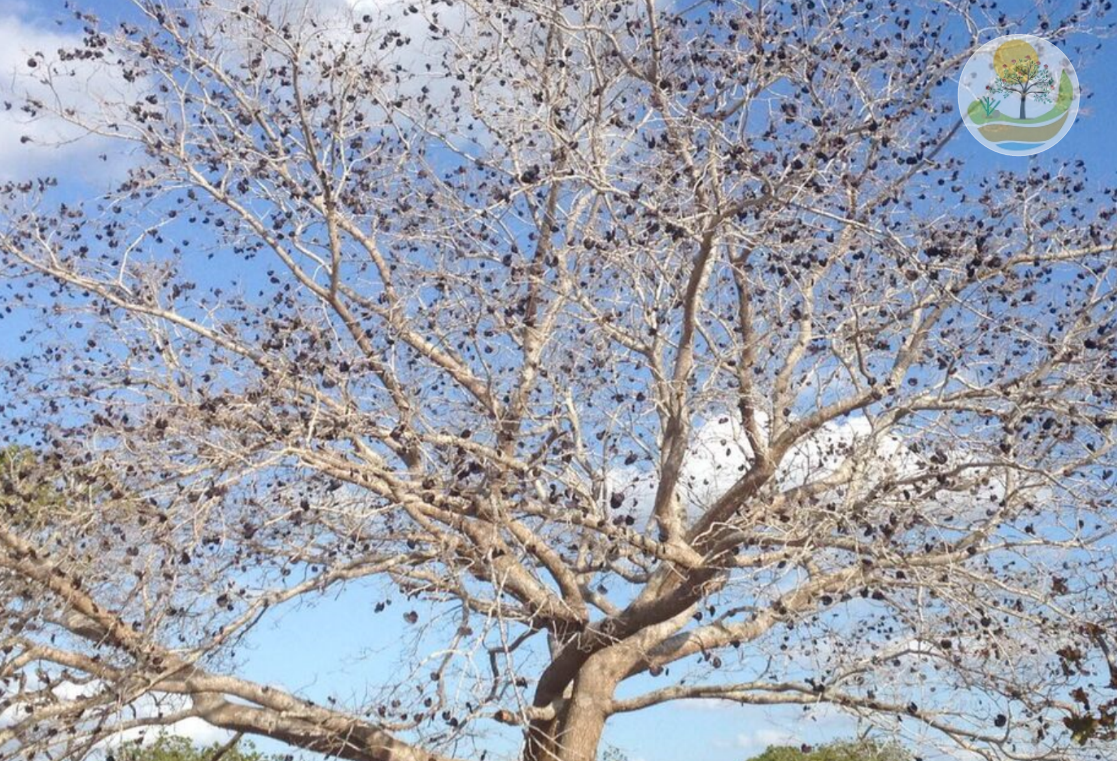
Defoliated tree with fruits.
The efficiency of seedling growth is related to the ability of plantlets to adapt themselves to the light conditions of the environment (MELLO, 2008). Light availability in forest environments is one factor that influences the development of plants; for the response to this factor, the species may be classified as pioneer or heliophytes (require direct solar radiation to germinate and satisfactory growth) and climax (tolerant to initial shadowing, germinating and growing up under closed canopy, with little lightness) (SWAINE & WHITMORE, 1998).
Many environmental factors (such as lightness, water, temperature, edaphic conditions) influence plant growth. The inadequate supply of one of those factors may drastically reduce the vigor and limit the development of a plant (SCALON et al., 2001). Within these factors, light, especially when considering its intensity, it is vital for the plant development and may interfere in processes such as photosynthesis rate and vegetative growth (FELFILI et al., 1999).
Seed technology
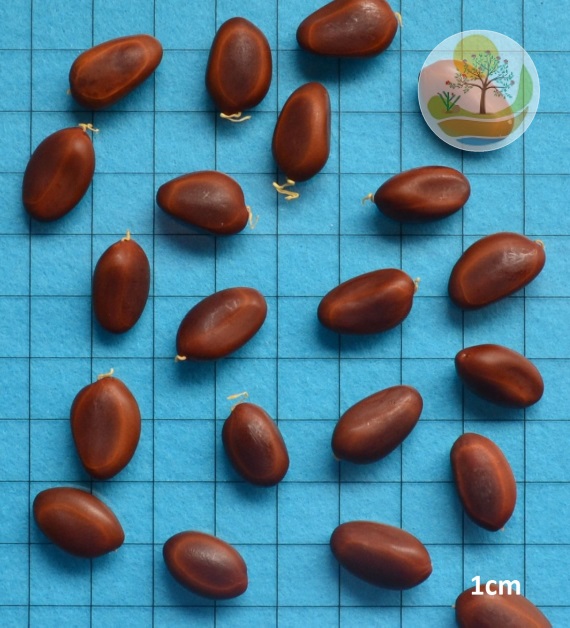
Seeds of Enterolobium contortisiliquum.
For the processing of Timbaúba seeds, one option is to expose fruits to sunlight to dry out and facilitate its opening and remove seeds by hand. Another option is to crush with a pestle to facilitate removal of seeds.
According to Link and Costa (1995), tow insects from Coleoptera order are easy to find in Timbaúba seeds, the Lephopodeum timbouvae and the Merobruchus bicoloripes, which have similar feeding behavior; together, both species were responsible to destroy 50% of seeds present in the pods.
The treatment with insecticide must be done. It is also recommended to select seeds and eliminated those with signs of attack by a microorganism (fungi, bacteria) and insects, and those with apparent damage.
This species has a tegument dormancy caused by the seed external layer resistance. And may also present embryo dormancy (LORENZI, 2008).
Alexandre et al. (2009), when assessing physical and chemical treatments to overcome dormancy in Timbaúba seeds, reported that the immersion of seeds in sulfuric acid for 10 minutes and the mechanical scarification with sandpaper obtained the best results.
Emergence occurs within 10 to 20 days after sowing, with germination rate greater than 25% (LORENZI, 2008).
< Go back to main page >
REFERENCES
- ALEXANDRE, R. S. et al. Tratamentos físicos e químicos na superação de dormência em sementes de Enterolobium contortisiliquum (Vell.) Morong. Revista Brasileira de Ciências Agrárias, 2009. (Abril-Junho).
- ARAÚJO, A. P.; SOBRINHO, P. Germinação e produção de mudas de tamboril (Enterolobium contortisiliquum (Vell.) Morong) em diferentes substratos. Revista Árvore, Viçosa, v. 35, n. 3, p. 581-588, 2011.
- APG III. Angiosperm phylogeny. Available at <http://www.mobot.org/MOBOT/research/APweb/>. Access 25 de jan de 2018.
- EIRA, M. T. S. ; FREITAS, R. W. A.; MELLO, C. M. C. Superação de dormência em sementes de Enterolobium contortisiliquum (Vell.) Morong – legumisae. Revista Brasileira de Sementes, Brasília, v. 15, n. 2, p. 177-181, 1993.
- FELFILI, J. M. et al. Comportamento de plântulas de Sclerolobium paniculatum Vog. Var. rubiginosum (Tul.) Benth sob diferentes níveis desombreamento em viveiro. Revista Brasileira de Botânica, São Paulo, v. 22, n. 2, p. 297-301, 1999.
- LINK, D.; COSTA, E.C. Danos causados por insetos em sementes de timbaúva, Enterolobium contortisiliquum (Vell.) Morong. Ciência Florestal, v.5, n1., p.113-122, 1995.
- LORENZI, H. Árvores brasileiras: manual de identificação e cultivo de plantas arbóreas do Brasil. Nova Odessa. Plantarum. 5ed. 384p. 2008.
- MELLO, R. R. Crescimento inicial de mudas de Enterolobium contortisiliquum (Vell.) Morong sob diferentes níveis de luminosidade. Revista Brasileira de Ciências Agrárias, Recife, v. 3, n. 2, p 138-144, 2008.
- SWAINE, M.D.; WHITMORE, T.C. On the definition of ecological species groups in tropical rain forests. Vegetatio, v. 75, p. 81-86, 1988.