
General information
Scientific nomenclature
Tabebuia aurea (Manso) Benth. & Hook. f. ex S Moore is an species from the Bignoniaceae family.
Local names
Craibeira, caraiberia, ipê-amarelo-craibeira, ipê-amarelo, ipê, aipê, ipê-branco, ipê-mamono, ipê-mandioca, ipê-ouro, ipê pardo, ipê-vacariano, ipê-tabaco, ipê-do-cerrado, ipê-dourado, ipê-da-serra, ipezeiro, and pau-d’arco-amarelo, taipoca (LORENZI, 1992).
Cultural and economic importance
Heavy and flexible wood, but it rots easily. It is used for paper fabrication, sportive objects, broomstick, and outside constructions. For those characteristics, they are interesting plants for the economy and woodwork (SANTOS; SUGAHARA; TAKAKI, 2005). Toasted seeds leaves may be used as a stimulant and replace erva-mate in the chimarrão (typical drink in Southern Brazil).
Ecological importance
The craibeira is a heliophyte species, which means it adapts its growth in an open environment and loses its leaves in a specific season of the year. It belongs to the group of secondary plants. Include the Mata Atlântica rainforest and the Semi-deciduous broad-leaved forest (DURIGAN and NOGUEIRA, 1990).
Phenology
Deciduous species. The loss of leaves coincides with the flowering period. Flowering initiates at the end of August, but climate phenomena may cause variation. Fructification is in September, October, November, December, January, and February, depending on the location. When cultivated, the reproductive process starts after the third year (CARVALHO, 2003).
Geographical distribution
It is present in the Cerrado, Caaringa, Amazônia, and Pantanal areas, however the morphological characteristics for each region is different, in the states of Amapá, Amazonas, Pará, Maranhã, Piauí, Ceará, Paraíba, Pernambuco, Rio Grande do Norte, Bahia, Goiás, Mato Grosso, Mato Grosso do Sul, Minas Gerais, São Paulo, and Paraná (LORENZI, 2009).
Botanic description
Size, crown shape, color, growth habit
Craibeira trees’ height may vary from 10 to 30 m (38.8 to 98.4ft), smaller in the Cerrado. Thick, tortuous and long branches. The craibeira has an elongated treetop with an enlarged base. The species prefers moist soils, with slow drainage, and not too wavy (LONGHI, 1995).
Vegetative characteristics
- Trunk and bark
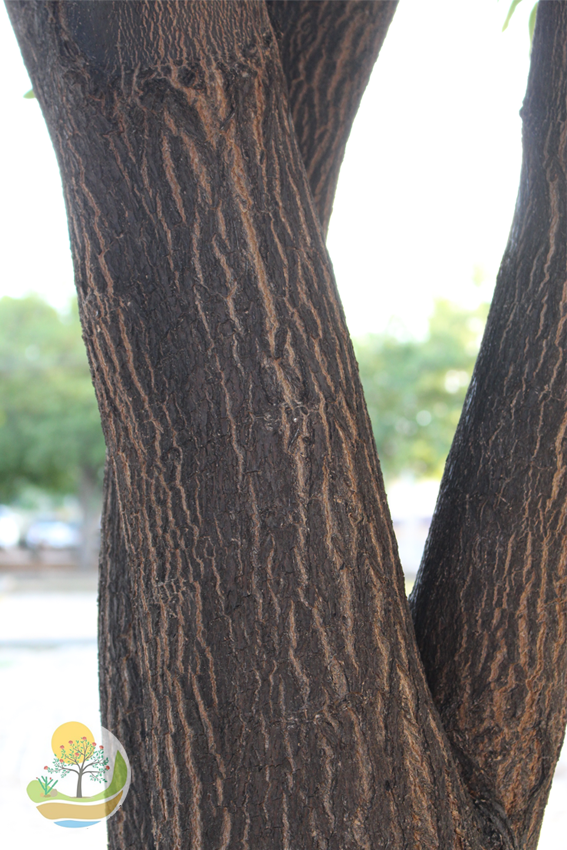
Bark of a Craibeira tree.
Tortuous trunk with thick bark.
- Leaves
Compound glabrous and subcoriaceous leaves with 3 to 7 leaflets.
- Flower/inflorescence
No information.
- Fruit, seeds and dispersal syndrome
Dehiscent cylindrical capsule.
Seed technology
Germination
The species is described as neutral photoblastic at 25ºC, with a high average germination (88 to 98%). Optimal temperature for germination is 35ºC (minimum of 20ºC and maximum of 40ºC), in absence of light.
Seed storage
Soon…
Seed health
According to Carvalho (2003), the Cydianerus bohemani beetle, from the Curculionideae family, and others beetles from the Chrysomellidae family are considered pests for this species. Zidko (2002), studying the association of beetles to trees, in the city of Piracibaca-SP, verified the presence of adult insects of Sitophilus linearis in reproductive structures.
Seedling production
Growth capacity
Seedling production must be done in direct sunlight exposition. The seedling reaches about 30 cm (11.8in) in 9 months, and tolerant to sunlight 3 weeks after germination. The substrate is prepared with a mix of sand, clay, and cattle manure, in equal proportion (MEDEIROS and CHIANCA, 2016).
< Go back to main page >
REFERENCES
- CARVALHO, P. E. R. Espécies arbóreas brasileiras. Brasília/Colombo: Embrapa Informação Tecnológica & Embrapa Florestas. p. 1-15. 2003.
- DURIGAN, G.; NOGUEIRA, J. C. B. Recomposição de matas ciliares. IF Série Registros, n. 4, p. 1-14, 1990.
- LONGHI, R.A. Livro das árvores: árvores e arvoretas do Sul. 2. ed. Porto Alegre: L&PM, 1995. 176p.
- LORENZI, H. Árvores brasileiras: manual de identificação e cultivo de plantas arbóreas nativas do Brasil. Nova Odessa: Ed. Plantarium, 1992. 352p.
- LORENZI, H. Árvores Brasileiras: Manual de Identificação e Cultivos de Plantas Arbóreas Nativas do Brasil, vol.2. 3. ed. Nova Odessa: Instituto Plantarum, 2009. 384p.
- SANTOS, D. L.; SUGAHARA, V. Y.; TAKAKI, M. Efeitos da luz e da temperatura na germinação de Tabebuia serratifolia (Vahl.) Nich., Tabebuia chrysotricha (Mart. ex Dc.) Standl. e Tabebuia roseo-alba (Ridl.) Sand. – Bignoniaceae. Ciência Florestal, Santa Maria, v.15, n.1, p. 87-92, 2005.